Silicone fluids are classified into two types: straight silicone fluids and modified silicone fluids.
| Grade | Features |
|---|---|
| DM-FLUID | The most common of silicone fluid product for general-purpose applications. Available in viscosities from 0.65 mm2/s to 1,000,000 mm2/s. Also available as a spray. |
| KF-965 | For high-temperature applications (-50°C to +250°C). Also available as a spray. |
| KF-968 | For high-temperature applications (-50°C to +250°C). Suitable as a heating medium in open systems. |
| KF-995 | Cyclic dimethyl silicone fluid. Volatile. No residue after evaporation, so cosmetics have a silky feel. |
| Grade | Features |
|---|---|
| F-5W-0 | For low-temperature applications (-60°C to +200°C). |
| KF-54 | For high-temperature applications (-30°C to +250°C). Suitable as a heating medium in open systems. |
| HIVAC F-4/ HIVAC F-5 |
Good oxidative stability and chemical resistance. For oil diffusion pump applications. For high-level vacuums of 10-7 to 10-12 Torr. Higher vacuums can be achieved with HIVAC F-5. |
| KF-56 | Alcohol-soluble. Used mainly as an additive in cosmetic products. |
| Grade | Features |
|---|---|
| F-9W-9 | Highly water repellent. Suitable for processing glass, metal, fibers, and powders. |
Common dimethyl silicone fluid is physiologically inert and has the characteristics of water repellency, defoaming properties, thermo-oxidative stability, and chemical stability. Modified silicone fluids are unique products that improve on the advantageous characteristics of dimethyl polysiloxane by introducing various organic groups into some of the methyl groups. Modification adds such properties as compatibility or reactivity with organic substances, water solubility, emulsifying properties, water repellency, paintability, anti-static properties, softening properties and lubricity.
Modified silicone fluids are used in wide-ranging applications, as ingredients in cosmetics, resin modifiers, textile treatment agents, additives for waxes, water repellents for construction applications, and release agents. They are also used in various industries to improve the function of existing polymeric materials and in the development of new materials.
| Modified type | Features | Applications |
|---|---|---|
| Amino-modified | Water repellency, reactivity, absorbability, lubricity, releasability, flexibility | Textile treatment agents, resin modifiers, paint additives, polishes, waxes |
| Epoxy-modified | Reactivity, absorbability, releasability, flexibility | Textile treatment agents, resin modifiers, waxes, paint additives |
| Carboxyl-modified | Reactivity, lubricity, releasability, flexibility | Textile treatment agents, resin modifiers, polishes, dispersants |
| Carbinol-modified | Reactivity, releasability, oxygen permeability | Resin modifiers, paint additives |
| Methacryl-modified | Reactivity, absorbability, oxygen permeability | Resin modifiers, paint additives |
| Mercapto-modified | Reactivity, absorbability | Paint additives, resin modifiers, corrosion retardants |
| Phenol-modified | Reactivity | Resin modifiers |
| Co-modified | Reactivity, compatibility | Waxes, resin modifiers, textile treatment agents, paint additives |
| Modified type | Features | Applications |
|---|---|---|
| Polyether-modified | Water solubility, water dispersibility, emulsifying | Ingredients in cosmetics, emulsifiers, foaming agents, plastic additives, anti-fogging agents, defoamers, textile treatment agents, water soluble lubricants |
| Methylstyryl-modified | Releasability, compatibility, lubricity | Paint additives, plastic additives, release agents |
| Alkyl-modified | Paintability, releasability, compatibility, lubricity | Paint additives, water repellents for construction applications, release agents |
| Special fluids modified with higher fatty acid ester | High melt point, compatibility | Resin modifiers, paint additives |
| Special modified fluids with hydrophilic properties | Water dispersibility, water solubility, lubricity, anti-fogging properties | Anti-fogging agents, textile treatment agents |
| Fluids containing higher fatty acids | High melt point, water repellency | Waxes, polishes |
| Fluorine-modified | Lubricity, chemical resistance, oil and solvent resistance | Lubricants, defoamers |
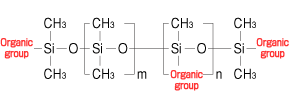
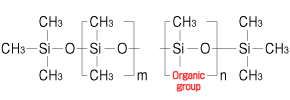
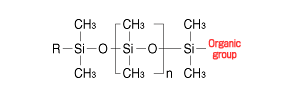
As shown below, the structures of modified silicone fluids are categorized into four major types, according to the position of the organic groups.
An organic group has been introduced into the polysiloxane side chain.
An organic group has been introduced into one end of the polysiloxane.
An organic group has been introduced into both ends of the polysiloxane.
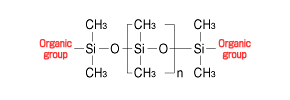
An organic group has been introduced into the side chains and both ends of the polysiloxane.