



01 What is silicone made of?
While the main chain of common organic synthetic polymers consists of repeating carbon (C) atoms, silicone is an "inorganic synthetic polymer" whose main chain is made of polysiloxane, which is the repetition of silicon(Si) and oxygen(O) atoms(1,2).
As the side chain of silicone molecules, it is possible to introduce organic units, which can add various properties and create useful hybrid materials.
The main sources of silicone are natural origin silica stone (SiO2), water, and natural gas-derived methanol. From these materials, through complex chemical reactions, silicone is synthesized. Taking the most widely produced polydimethylsiloxane as an example, about 60% of the constituents are derived from silica and water.
Abundance (by weight) of elements found in earth's crust (Top 5)
| Order | Element | Clarke number* |
|---|---|---|
| 1 | Oxygen | 49.5 |
| 2 | Silicon | 25.8 |
| 3 | Aluminum | 7.56 |
| 4 | Iron | 4.70 |
| 5 | Calcium | 3.39 |
*Clarke number: indicates the abundance of elements near the earth's surface, expressed as a percentage by weight.
1
Chemical Abstracts Service (CAS), worldwide authorities of chemical information, index silicone polymers with control terms such as Polysiloxanes and Siloxanes and Silicones and classify them as inorganic polymers.
2
In 2007, International Union of Pure and Applied Chemistry (IUPAC) defined inorganic polymers as polymeric compounds that do not contain carbon atoms in their main chains.
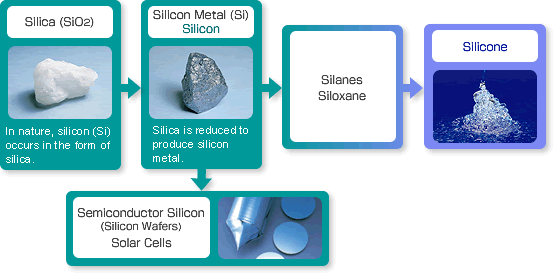
Silicone vs. Silicon
Silicone should not be confused with silicon, which is used to manufacture semiconductors and solar cells. The term "silicone" refers to a family of manmade compounds, of which silicon (Si) is a key element. Shin-Etsu Handotai (part of the Shin-Etsu Group) produces semiconductor-grade silicon, and is the world's leading producer.